Dear Susanna
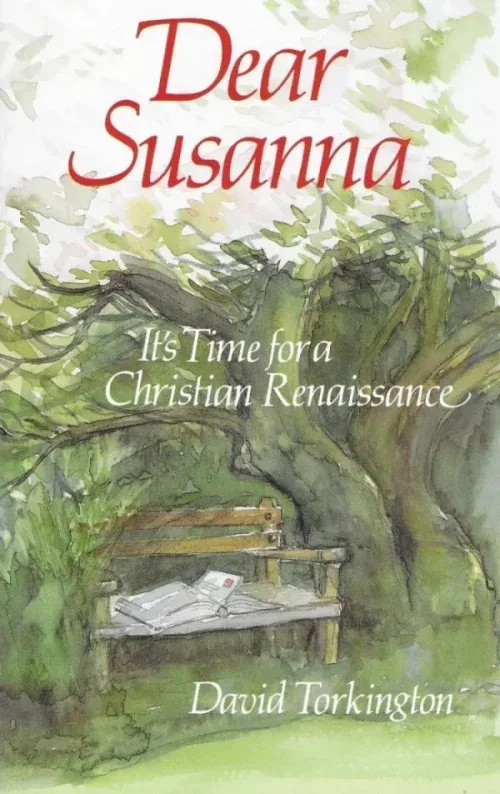
David Torkington first knew Susanna as a child. When she re-entered his life as an adult, a letter she wrote to him questioning aspects of her faith sparked off the correspondence contained in this book.
Extract from Dear Susanna
Letter 15: Christian Stoics
Dear Susanna
Yet again I say to you, Christianity is a Mysticism not a Moralism. Jesus is firstly a Mystic not a moral philosopher. When we understand this not just with our minds and hearts but with our whole being and begin to do something about it we will have put aside the Christian humanism with which all too many of us were brought up. Then at last we will be on our way back to living the Gospel that was lived and preached by the first Christians in imitation of the man they lived and died for.
If we have been brought up as “bastard Christians”, then through no fault of our own, it’s time to make ourselves legitimate once more, by returning to the unalloyed Christian spirituality that inspired the first Christians immediately after the Resurrection. We’ve had a classical renaissance in the middle of the last millennium now I believe its time for a Christian renaissance to restore Christianity to what it should be. What better enterprise with which to celebrate the third millennium!
Love
David
Reviews for Wisdom from Dear Susanna
David Torkington uses the format of a series of letters to lay before Susanna, and the reader, what he considers to be the crucial element of deep Christian living. The Catholic Church comes under scrutiny, as does the movement in Christian thought away from faith as an experience, towards faith as a moral belief system. This change, originating in ideas born of Socrates, Aristotle and Plato, culminated in the heresy of Pelagias, who maintained that man could achieve perfection by his own efforts. In spite of the Church’s rejection of this notion, Torkington argues that the idea that we can achieve closeness to God by our own striving and efforts remains endemic. His advice to Susanna, and to the reader, is to accept once again the mystical nature of God, and to enter into this mystery. By committing regular time to silent prayer, through which God is enabled to suffuse our beings with his love, our own capacity to love and live in a Christ-like way will be dramatically enhanced. This is an extremely readable book, and the author writes with considerable authority and intimate knowledge of the material covered.
Melaniejmott@aol.com Amazon Reviewer
Every book David Torkington writes is about prayer, the true deep prayer of the heart that surrenders us to the Father of Jesus. Put in another way, all his books are about holiness, but so simply expressed, so colloquial, that we understand the total love of God as the essential act of being human. His latest book, Dear Susanna, is perhaps his best, refining the gentleness of unpretentiousness to a captivating ease. Torkington speaks to us from his own weakness and failures: he does not expound, he reveals, taking us with him on our own blundering search for faith. He writes about real faith, transforming and wholly non-judgmental, clear as spring water and as refreshing. It is this very simplicity that makes him so challenging. Remember how the professionally virtuous, the Pharisees, disdained Jesus because of his accepted humanity? He ate, he drank, he associated happily with sinners. The Pharisees expected a man of God to have an abnormal and striking life-style. So, today, serious seekers for God, students of contemplation, will warm to a book with a complex title and an impressive cover. They tend to think that Torkington’s books, so easy to read, so attractive, so interesting, are therefore less serious. But their seriousness is that of Jesus himself, a matter of the inner spirit and not that of the outer casing. This book grounds itself in the condition of the contemporary church. It discusses frankly and humbly its failings and blindnesses, not to condemn but to call on us to respond with hope in a ‘Christian Renaissance’, the book’s subtitle. The young married Susanna to whom these letters were written, received a treasure, and it is one she graciously shares with us. This is a book that would delight both St Teresa and St John of the Cross.
Sr Wendy Beckett – Hermit