
Some years ago, I shared a flat with a man called Caruthers. If ‘morals make the man, and manners make the gentleman’, then Caruthers was the finest gentleman I had ever met, or so I thought for the first few weeks. However, as the weeks went by, I began to see that his manners were no more than a thin coat of veneer that hid the chipboard man within. Casual visitors were as impressed with him as I had been to begin with. He was always ‘so terribly sorry’ for everything. He was ‘so terribly sorry’ for beating me to the bathroom, ‘so terribly sorry’ for keeping me waiting for half an hour, ‘so terribly sorry’ for failing to clean the bath.
He was ‘so terribly sorry’ too for emptying the fridge when he had his friends round, for leaving the washing-up for me the following morning, and for leaving my car with an empty tank when he borrowed it without asking. The trouble was, he wasn’t sorry at all and he kept on behaving in the same old way day in, day out. It is one thing to say you are sorry; it is quite another to mean it. If you mean it, you do something about it. No act of sorrow, no promise to do better next time however heartfelt it might sound, will do us any good, if we do not resolve and seriously endeavour to do better next time round.
Finally, as we become a little more aware of the moral stumbling blocks that usually trip us up, it is time to try and forestall them. If there is a lazy streak in us, or if we have a hot temper, or are prone to making ‘smart alec’ remarks at the expense of others, it is the time to take the necessary steps to avoid falling into these same faults in the forthcoming day. St Paul was the first to realise with such clarity, that it is in fact our very weaknesses, and that even includes our sins, that can become stepping stones to sanctity, if they only convince us of our utter need for God.
For God’s power can find full scope in our weakness (2 Corinth 12:9). This is good news, because the truth is, in this life we will never stop falling no matter what. Remember the words of the hermit, Peter Calvay – “When you stop falling you will be in heaven, but when you stop getting up, you will be in Hell!”
The Difference Between Saints and Sinners
The difference between us and the saints is not that they did not sin and we do – they sinned just as we do, make no mistake about it. But what distinguishes the saint from the sinner is the speed with which they get up after having fallen. The saint does not waste precious time pretending that they did not sin, or by making endless excuses, or blaming others for what they know only too well was their fault.
They get up again the moment they fall to seek forgiveness and begin again, knowing that they have sinned, but trusting implicitly in the mercy of God. St Francis said that the very moment that a person sins must be the moment to turn back to God begging his forgiveness – immediately and without delay. Herein lies one of the main differences between the saints and sinners like us. Only too often people simply cannot face their guilt so they run away from God and hide as Adam did in the Garden of Eden.
When God called out “Adam, Adam, where are you?” – he knew exactly where Adam was, it was Adam who did not know where he was, for he had lost his way trying to hide his sin and the guilt that shamed him.
Sometimes we can spend years on the run, because pride won’t allow us to admit what we have done and, our inability to eat humble pie, means that we can spend half a lifetime suffering from spiritual starvation.
What is even worse than the pride that comes before a fall, is the pride that follows the fall, because it stops us from getting up, sometimes permanently!
Interesting how your roommate’s insincere apologies covered up a totally self-absorbed nature. We all need to guard against this kind of selfishness and lack of consideration for others, as it’s so easy to fall into that trap.
My particular weakness is my impatience and quick tongue that sometimes can answer back and/or make cutting remarks when I should just ignore. I get discouraged at how often I fall, but I know I must keep trying!
Gloria,
Thank you for your honest appraisal. We all find ourselves in these situations where we need to admit our weakness and try to improve.
Bless you.
This is my first time visiting your blog, Mr. Torkington. “A Cautionary Tale for Lent” is also the first posting of yours that I have read. I was drawn in by your tale of Caruthers. I laughed because as a college professor, I am surrounded by disciples of Caruthers.
What you have written makes an important point but one that is not fully appreciated today. I have noticed that in the college in which I teach, the province in which I reside, the country in which I am a citizen, the word “sin” is never used. Where I am from, when a person “falls”, it is not because of sin. Government, agencies, educators, therapists, talking heads rush to form committees and task forces to outline and examine and provide the anthropological, sociological, physiological, psychological, sexual, patriarchal, and political explanations as to why he or she fell; what group was responsible for setting up that person to fall; why that person does not need to get up at this point. If sin cannot be spoken about or even acknowledged, can people ever truly know why they fell in the first place? And can they ever know that it is not self-help books, programs, workshops or whatever that is required in rising again? If we cannot accept that sin exists, can we even begin to comprehend the existence of Grace?
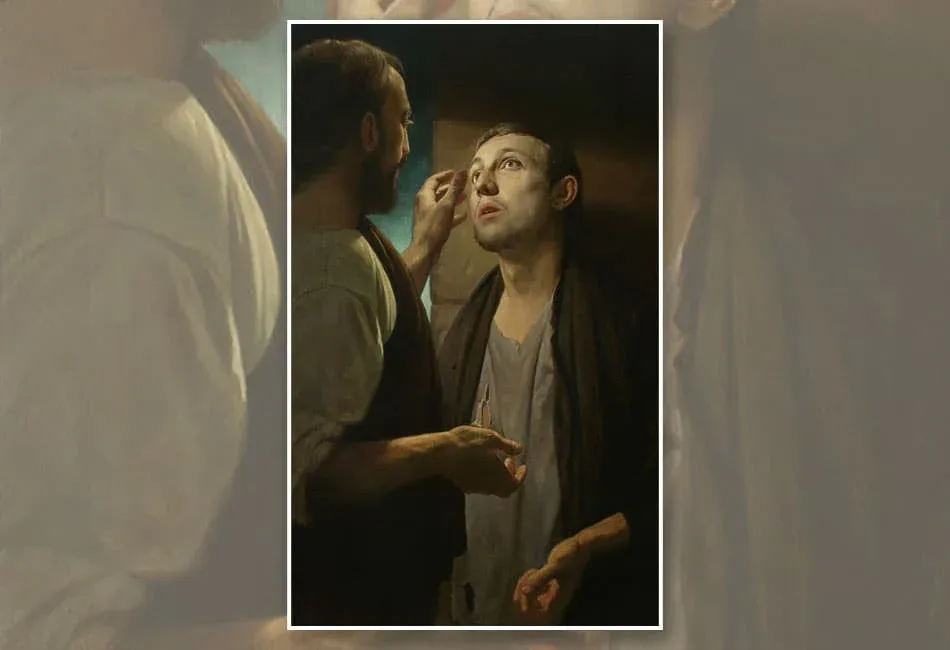
P.S. The image you chose for this post is very moving. Thank you for introducing me to it and its creator.
God bless you and your wonderful blog.
Such important points you raise, TMJC. Thank you for adding them to my site.
David
This one came close to home for me: starting the “self-examination” Melanie Juneau mentioned. It hurt a bit, which in this case is a good thing. Thank you.
It’s close to home for us all, Brian. Thanks for your insight.
The difficult part is taking the first step on the long arduous journey to the point where we ganuinly want to give up our ‘comforter’, that is the sin we have become so addicted to!
How true Leon, and so good to hear from you.
A masterful piece; it manages to amuse but deliver a punch of truth leading to self-examination at the same time- love it
Bless you Melanie
you are my mentor- a storyteller who can deliver spiritual and theological truths couched in a fascinating, riveting narrative.
umm- when I simply relax I can do reviews- is it too late for your book?
Never too late Melanie. Just finishing the last editing and would be honoured if you would review.
wonderful